
CCTV Security Systems
A stable network so recorded footage and app viewing don't drop out.
Explore CCTV installationStructured cabling and network setups that keep CCTV, alarms and everyday devices connected, for homes and businesses across South East Queensland.
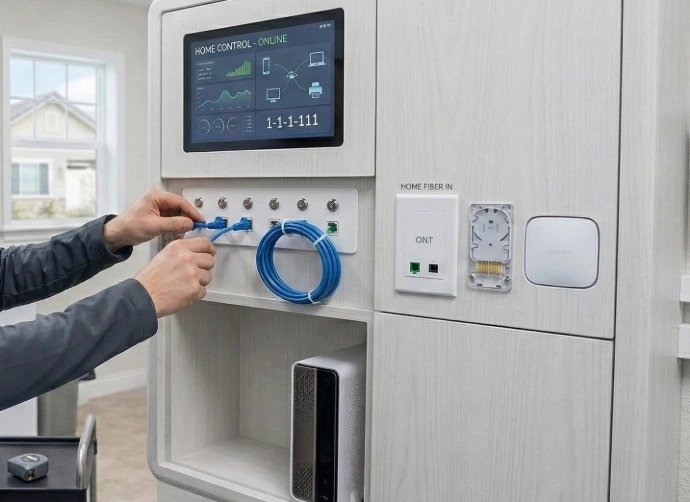
Most cabling jobs start with a walk-through to find the weak points: a camera at the back fence that keeps dropping out, a home office with patchy WiFi, a smart TV point that was never wired properly during the build. From there it's running cable to a central point (or adding one), terminating it properly onto a patch panel or wall points, and testing every run before it's called finished.
Where the job is about fixing WiFi coverage rather than adding wired points, that can mean running a single cable to a new access point in the right spot, rather than just adding another cheap extender that halves your speed with each hop.
A CCTV camera or an alarm sensor that relies on WiFi is only as good as the signal it's sitting on. A camera at the side of the house or back near a shed is often at the exact edge of a router's range, which is where dropouts, delayed alerts and gaps in recorded footage tend to happen. Running a data cable to that camera, or placing an access point to properly cover that zone, fixes the actual problem instead of hoping a stronger router helps.
Mainly the number of data points, how far cable needs to run and how accessible that path is (roof space, wall cavities, or exposed conduit), whether it's a finished property or one still under construction, and whether existing cabling can be reused or needs replacing.
Have a think about which specific areas have been a problem, whether it's mainly about security devices, general WiFi, or both, and whether you're open to a wired point in a visible spot (like a hallway cupboard) if that's what actually solves the coverage issue.
Stacking multiple cheap extenders in a line, which drops speed at every hop; running cable without testing each end, so a fault isn't found until a camera or device won't connect; ignoring interference from things like old cordless phones or metal roofing; and treating a wiring problem as a WiFi problem, buying a new router when the actual fix was a single cable run.
A stable network so recorded footage and app viewing don't drop out.
Explore CCTV installationReliable connectivity so app alerts arrive in real time.
Explore alarm systemsA strong signal so app-based intercoms respond instantly.
Explore intercom installationNew estates and older homes with limited existing cabling.
View Logan service areaQueenslanders and character homes with awkward cable runs.
View Brisbane service areaHigh-rise units and gated estates.
View Gold Coast service areaWireless cameras and app-connected alarms are only as reliable as the network they sit on. A weak signal at the front gate or the back shed causes dropouts and missed alerts. Proper cabling or a purpose-placed access point fixes that at the source instead of masking it.
It's running proper data cable (rather than relying only on WiFi) from a central point to each area that needs a strong, stable connection, such as a camera position, an office desk or a smart TV point, so that area gets a wired-quality connection even if it also has WiFi available.
Yes. Office and shopfront cabling jobs are common: desk points, a dedicated run for a CCTV NVR, and a tidy patch panel instead of a tangle of cables behind a desk or in a cupboard.
Usually, yes. Either by running a data cable to a new access point in that area, or by repositioning and reconfiguring the existing router and any extenders so the signal reaches where it's actually needed.
The property location, which rooms or outdoor areas need a stronger connection, whether it's for security devices, general WiFi, or both, and whether it's a new build, renovation or existing finished property.
Tell us which areas are giving you trouble and we'll come back with options that fit.